Ethereum co-founder Vitalik Buterin has unveiled an ambitious vision to fundamentally redesign Ethereum’s architecture, aiming to make the network “as simple as Bitcoin” within the next five years. The proposal, published on May 3, represents a significant philosophical shift toward minimalism and efficiency that could reshape Ethereum’s development trajectory for years to come.
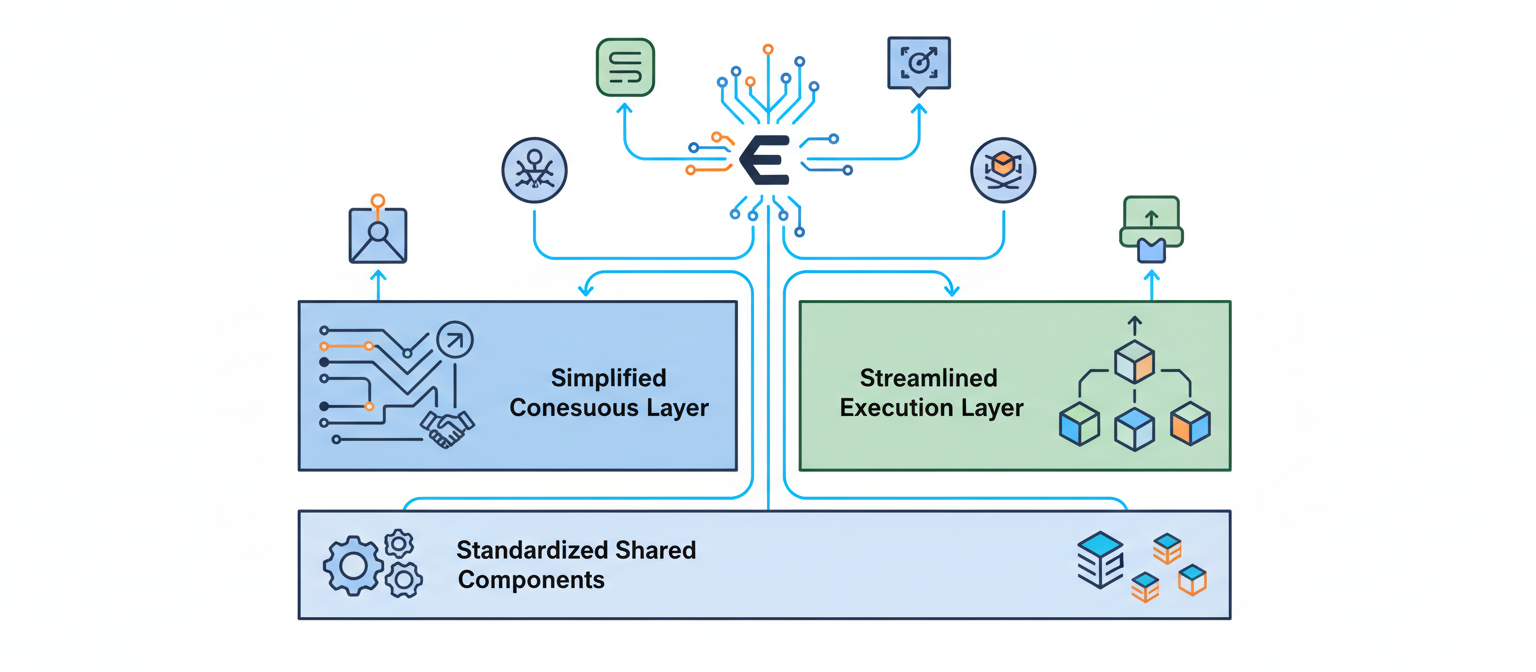
In a comprehensive blog post titled “Simplifying the L1,” Buterin outlined a detailed roadmap to streamline Ethereum’s base protocol across consensus, execution, and shared components. The initiative comes as Ethereum faces increasing competition from simpler blockchain architectures and growing concerns about protocol complexity.
The Case for Simplicity
Buterin’s proposal begins with a candid acknowledgment of Ethereum’s current complexity challenges. He argues that while recent upgrades like proof-of-stake (PoS) and zero-knowledge proof integration have enhanced Ethereum’s capabilities, they have also introduced significant technical complexity that has led to bloated development cycles, higher costs, and increased security risks.
“Historically, Ethereum has often not done this (sometimes because of my own decisions), and this has contributed to much of our excessive development expenditure, all kinds of security risk, and insularity of R&D culture, often in pursuit of benefits that have proven illusory,” Buterin wrote, taking personal responsibility for past complexity-focused decisions.
The proposal emphasizes that simplicity is crucial for Ethereum’s long-term resilience and scalability. By reducing protocol complexity, Buterin believes Ethereum can achieve greater efficiency, security, and accessibility while maintaining its core functionality and innovation capacity.
3-Slot Finality: Consensus Layer Revolution
At the heart of Buterin’s consensus layer proposal is the innovative “3-slot finality” model, which would eliminate several complex components from Ethereum’s current architecture. This model would remove epochs, sync committees, and validator shuffling mechanisms that currently add significant complexity to the consensus process.
The reduced number of active validators at any given time would enable the use of simpler fork choice rules, enhancing network security while reducing implementation complexity. This approach represents a fundamental departure from Ethereum’s current consensus design, prioritizing simplicity and efficiency over the intricate coordination mechanisms currently in place.
Additional consensus improvements include adopting Scalable Transparent Argument of Knowledge (STARK)-based aggregation protocols to decentralize and simplify network coordination. These protocols would replace more complex existing systems while maintaining robust security guarantees.
RISC-V Virtual Machine: Execution Layer Transformation
Perhaps the most radical aspect of Buterin’s proposal involves the execution layer, where he suggests transitioning from the current Ethereum Virtual Machine (EVM) to a simpler, zero-knowledge-friendly virtual machine based on RISC-V architecture.
RISC-V, an open-source instruction set architecture known for its minimalist design philosophy, could offer dramatic performance improvements for zero-knowledge proofs while significantly simplifying the protocol. Buterin estimates that this transition could deliver 100x performance improvements for ZK computations, a critical capability for Ethereum’s scaling roadmap.
To ensure backward compatibility during this transition, Buterin proposes running legacy EVM contracts on-chain via a RISC-V interpreter while supporting both virtual machines concurrently during a transitional phase. This approach would allow developers and users to migrate gradually without disrupting existing applications.
Protocol-Wide Standardization Initiative
Beyond consensus and execution improvements, Buterin calls for comprehensive protocol-wide standardization to eliminate redundant complexity across Ethereum’s architecture. This includes adopting a single erasure coding method, standardized serialization format (favoring Simple Serialize or SSZ), and unified tree structures.
The standardization effort would streamline Ethereum’s tooling and infrastructure, reducing development overhead while improving interoperability between different components and implementations. By establishing consistent standards across the protocol, Ethereum could achieve greater efficiency and reduced maintenance costs.
Buterin also suggests implementing a “max line-of-code” target for consensus-critical logic, similar to practices used by projects like Tinygrad. This approach would keep core protocol logic as lean and auditable as possible, with non-critical legacy features moved outside the core specification while remaining functional.
Competitive Landscape Context
Buterin’s simplification proposal comes at a crucial time for Ethereum, as the network faces increasing competition from newer blockchain platforms that have gained market share through simpler architectures and more focused value propositions.
During a panel discussion at the LONGITUDE by Cointelegraph event on May 2, Alex Svanevik, CEO of blockchain analytics firm Nansen, noted that Ethereum’s relative dominance among Layer 1 blockchain networks has been declining. “If you’d asked me 3-4 years ago whether Ethereum would dominate crypto, I’d have said yes,” Svanevik observed. “But now, it’s clear that’s not what’s happening.”
This competitive pressure appears to be a significant factor driving Buterin’s proposal. By simplifying Ethereum’s architecture, the network could potentially improve its competitive position while maintaining its robust developer ecosystem and extensive application layer.
Implementation Timeline and Challenges
Buterin’s five-year timeline for this transformation reflects the magnitude of the proposed changes. Implementing such fundamental architectural modifications while maintaining network security and backward compatibility presents significant technical and coordination challenges.
The proposal would require extensive community consensus, significant development resources, and careful coordination across Ethereum’s diverse ecosystem of developers, users, and applications. However, if successful, the simplification could position Ethereum for long-term sustainability and competitiveness.
Industry Implications
The proposal has significant implications for the broader cryptocurrency industry. If Ethereum successfully implements these simplifications, it could set a new precedent for how established blockchain networks address complexity and scalability challenges. The move toward Bitcoin-inspired minimalism from the world’s second-largest cryptocurrency would represent a significant philosophical shift in the industry.
Furthermore, the emphasis on zero-knowledge proof optimization and RISC-V integration could accelerate broader adoption of these technologies across the cryptocurrency ecosystem, potentially influencing how other blockchain platforms approach protocol design and development.
Looking Ahead
As the Ethereum community begins to digest and discuss Buterin’s proposal, the coming months will be crucial for determining the level of support and the feasibility of implementation. The proposal represents both a technical roadmap and a philosophical statement about the future direction of Ethereum development.
Success would require unprecedented coordination across Ethereum’s diverse stakeholders, but the potential benefits include a more efficient, secure, and competitive Ethereum network capable of sustaining its position as a leading platform for decentralized applications and financial innovation.
This article reflects information available as of May 4, 2025. Technical developments and community responses to Buterin’s proposal may have evolved since publication.