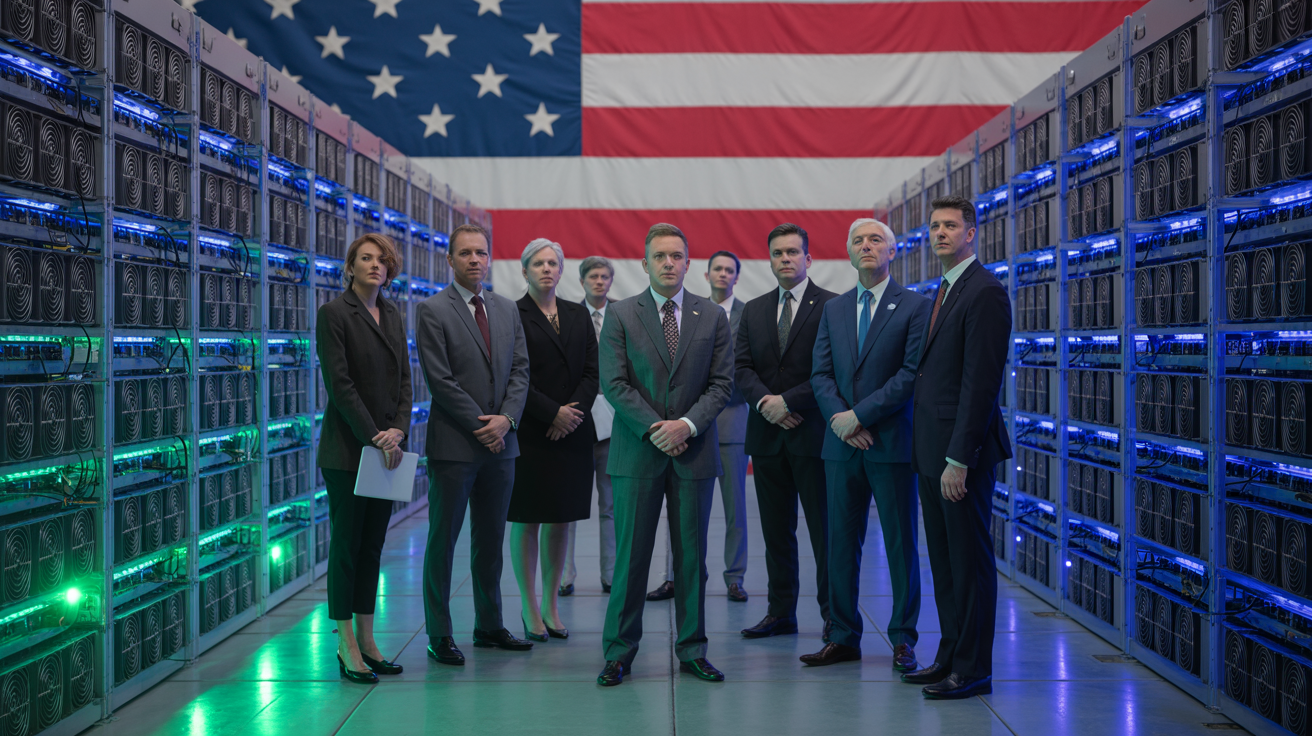
President Donald Trump’s sons launched a Bitcoin mining venture today in partnership with publicly-traded miner Hut 8, entering an industry that just closed its worst quarter in seven years amid plunging profitability and mounting operational challenges.
The new company, called American Bitcoin, pairs the Trump family’s political influence with Hut 8’s mining infrastructure at a moment when the broader mining sector faces unprecedented pressure from declining Bitcoin prices, soaring network difficulty, and razor-thin profit margins that are driving smaller operators out of business.
American Bitcoin: Structure and Ownership
Under the partnership announced today, Hut 8 will contribute substantially all of its Bitcoin mining equipment—approximately 61,000 specialized ASIC chips—to American Bitcoin in exchange for an 80% equity stake in the new entity.
Eric Trump and Donald Trump Jr. are merging their firm, American Data Centers, with the mining venture to take the remaining 20% ownership stake. Eric Trump will serve as the company’s co-founder and chief strategy officer, while Matt Prusak, formerly Hut 8’s chief commercial officer, will serve as CEO.
The board of directors includes high-profile technology entrepreneurs, with Tinder co-founder Justin Mateen and FabFitFun co-founder Michael Broukhim joining Eric Trump in governance roles.
Operationally, Hut 8 will host American Bitcoin’s mining operations across its 11 U.S. data centers and manage all core business functions including human resources, finance, compliance, and day-to-day mining operations. Hut 8 CEO Asher Genoot emphasized that the partnership leverages the company’s low energy costs and scalable infrastructure to provide competitive advantages.
“We are thrilled to partner with Eric and Don Jr. to launch American Bitcoin,” Genoot stated in today’s announcement. “This partnership combines Hut 8’s operational excellence with the Trump family’s vision for American leadership in Bitcoin mining.”
The 80-20 ownership split means Hut 8 retains operational control while the Trump family gains significant exposure to Bitcoin mining revenues—and potential conflicts of interest given President Trump’s ongoing policy influence over cryptocurrency regulation and energy markets.
Timing Raises Eyebrows
The launch of American Bitcoin comes at a peculiar moment for the Bitcoin mining industry, which just completed its worst first quarter performance since 2018.
Bitcoin’s price declined approximately 12% during Q1 2025, dropping from around $106,000 in early January to roughly $80,200 by quarter-end—the worst Q1 performance in seven years. For an industry whose profitability depends directly on Bitcoin’s dollar value, the price decline has been devastating.
Mining company financials paint an even grimmer picture. Seven of the eight largest publicly-traded U.S. Bitcoin miners are projected to report losses for Q1 2025, collectively swinging from $1.1 billion in adjusted net income in Q1 2024 to an estimated $190 million loss this quarter.
Phoenix Group reported a staggering $153.6 million loss for Q1—a dramatic reversal from its $66.2 million profit in the same period last year. Riot Platforms saw its cost to mine each Bitcoin nearly double year-over-year, from $23,034 to $43,808, while Cango faced the highest mining costs among major operators at $70,602 per Bitcoin.
Brian Dobson, managing director at Clear Street, captured the industry’s struggles: “Q1 2025 was particularly challenging for Bitcoin miners.”
The operational headwinds are multifaceted. Network mining difficulty reached all-time highs in recent months, meaning miners must deploy more computational power—and consume more electricity—to earn the same Bitcoin rewards. Rising electricity prices in key mining hubs have further compressed margins, while Bitcoin’s 12% price decline eliminated gains that might have offset increased operational costs.
Against this backdrop, the Trump family’s entry into Bitcoin mining appears either contrarian or opportunistic, depending on one’s perspective. Bulls might argue that launching during industry distress positions American Bitcoin to acquire assets cheaply and consolidate market share. Skeptics question whether political connections rather than business fundamentals drove the venture’s formation and financing.

Conflict of Interest Concerns
The American Bitcoin launch immediately raises conflict of interest questions given President Trump’s influence over policies directly affecting cryptocurrency mining profitability and viability.
Energy policy stands as the most obvious concern. Bitcoin mining is extraordinarily energy-intensive, with large operations consuming electricity equivalent to small cities. Federal and state energy regulations, subsidies, tax incentives, and infrastructure investments can dramatically impact mining economics.
President Trump’s administration has already demonstrated strong support for cryptocurrency industry development, signing an executive order in January titled “Strengthening American Leadership in Digital Financial Technology” that directed federal agencies to develop favorable regulatory frameworks for digital assets.
In March, Trump signed another executive order establishing a Strategic Bitcoin Reserve comprised of digital assets seized by the government—a policy that indirectly supports Bitcoin prices by signaling government endorsement of the asset class. Higher Bitcoin prices directly benefit mining profitability and the Trump family’s new venture.
Cryptocurrency regulation represents another policy area where presidential influence could benefit American Bitcoin. The SEC’s recent shift away from aggressive enforcement toward clearer rulemaking—marked by the creation of Commissioner Hester Peirce’s Crypto Task Force and the dismissal of enforcement cases against major exchanges—has already created a more favorable environment for cryptocurrency businesses.
Environmental and energy regulations could similarly impact mining operations. Bitcoin mining’s energy consumption has drawn criticism from environmental groups, and federal policy on renewable energy incentives, carbon pricing, or electricity market structure could advantage or disadvantage mining operations depending on how rules are crafted.
Democratic lawmakers have already signaled concern about cryptocurrency-related conflicts of interest involving the Trump family. Senator Elizabeth Warren and Senator Jeff Merkley called a separate Trump crypto business deal a “staggering conflict of interest” and requested investigations into potential constitutional violations.
The American Bitcoin venture provides even more direct financial exposure for the Trump family, as the 20% equity stake could be worth hundreds of millions of dollars depending on the company’s valuation and Bitcoin’s future price trajectory.
Eric Trump dismissed conflict of interest concerns in previous statements about the family’s cryptocurrency ventures, arguing that President Trump is not personally involved in business decisions. However, critics note that family financial interests in industries subject to federal regulation create inherent conflicts regardless of direct presidential involvement in day-to-day operations.
Industry Consolidation Accelerates
Beyond the political implications, American Bitcoin’s formation reflects broader consolidation trends in the Bitcoin mining industry as smaller operators struggle to survive.
The post-halving environment has proven brutal for mining economics. Bitcoin’s April 2024 halving reduced block rewards from 6.25 BTC to 3.125 BTC, cutting miners’ primary revenue source in half. Combined with increasing network difficulty and volatile Bitcoin prices, many smaller mining operations have become unprofitable.
Industry data shows that sustainable mining in 2025 requires electricity costs of approximately $0.05 per kilowatt-hour or lower. Operators paying higher power rates are mining at a loss or barely breaking even, creating pressure to shut down operations or sell assets to better-capitalized competitors.
American Bitcoin’s partnership structure suggests Hut 8 is leveraging the deal to consolidate mining capacity under favorable terms while the Trump family provides capital, political connections, and brand value. The 80-20 ownership split ensures Hut 8 retains operational control and the majority of economic upside while associating with a politically powerful family whose policy influence could benefit the venture.
For the mining industry broadly, American Bitcoin represents another data point in the professionalization and consolidation of what was once a more decentralized ecosystem. Large, well-capitalized mining operations with access to cheap power and efficient equipment are increasingly dominating Bitcoin mining, while smaller hobbyist and medium-sized commercial miners face existential challenges.
The involvement of political families like the Trumps further signals Bitcoin mining’s evolution from a cryptographic curiosity to a mainstream industrial activity attracting institutional capital and political attention—along with the conflicts, controversies, and regulatory complexities that accompany such attention.
Market Implications
Bitcoin’s price response to today’s American Bitcoin announcement was muted, suggesting markets are more focused on macroeconomic factors and industry fundamentals than political developments.
However, the Trump family’s formal entry into Bitcoin mining could have longer-term implications for industry perception and policy development.
On the positive side, high-profile political involvement may legitimize Bitcoin mining in mainstream business and policy circles, potentially attracting additional institutional capital and creating pressure for favorable regulatory treatment. President Trump’s public support for cryptocurrency during his 2024 campaign and his administration’s early crypto-friendly policies have already shifted industry sentiment positively.
The negative case centers on the conflict of interest concerns and potential backlash if American Bitcoin is perceived as benefiting from insider political access rather than competitive business advantages. Cryptocurrency advocates have long emphasized the industry’s decentralized, apolitical nature as a feature distinguishing digital assets from traditional finance. High-profile political family involvement in mining operations undermines that narrative and could invite additional regulatory scrutiny.
For Hut 8 specifically, the partnership provides immediate benefits through association with a politically connected family while retaining operational control and majority ownership. The company’s stock price will likely respond to both Bitcoin mining fundamentals and political developments affecting the Trump family in coming months.
Looking Ahead
As American Bitcoin begins operations, the venture faces the same economic headwinds battering the entire mining sector: compressed margins, intense competition, and volatile Bitcoin prices.
The company’s success will depend on factors including Bitcoin’s price trajectory in coming quarters, network difficulty trends, access to low-cost power, and operational efficiency. Political considerations may provide ancillary advantages through favorable policy treatment, but they cannot overcome fundamental economics if Bitcoin prices remain depressed or mining difficulty continues rising.
For the Trump family, American Bitcoin represents the latest in a series of cryptocurrency ventures that have attracted both enthusiasm and controversy. The family launched a DeFi protocol called World Liberty Financial earlier this year and has promoted various cryptocurrency projects, blurring lines between political office and business interests in ways that generate regular ethics debates.
For the mining industry, today’s announcement underscores the sector’s transition from a niche technical pursuit to a politically-engaged, institutionally-backed industrial activity. Whether that evolution ultimately benefits or harms Bitcoin’s decentralized ethos remains to be determined.
What’s clear is that the intersection of political power and cryptocurrency mining has arrived, bringing both opportunities and complications for an industry that built its reputation on being beyond the control of governments and traditional power structures.
As Q1 2025 closes as the worst quarter for Bitcoin mining in seven years, American Bitcoin’s launch serves as a test case for whether political connections can overcome poor industry fundamentals—or whether the fundamental economics of mining will determine outcomes regardless of who sits in the White House.
This article reflects information available as of March 31, 2025.