
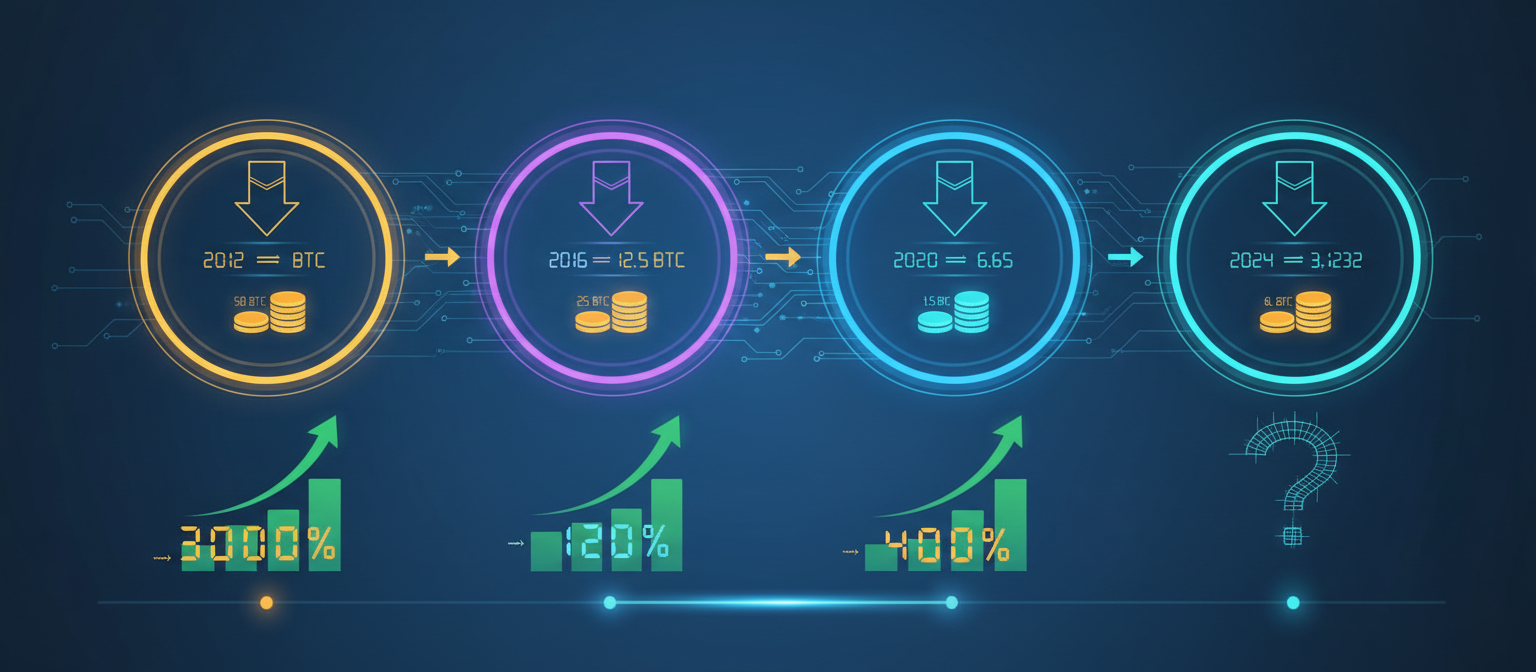
Bitcoin has successfully completed its fourth halving event, with block 840,000 being mined yesterday at approximately 9:09 PM EST, marking a historic moment in the cryptocurrency’s timeline. The event has slashed mining rewards from 6.25 BTC to 3.125 BTC per block, effectively cutting daily new Bitcoin supply from 900 to 450 coins.
The halving, which occurs approximately every four years as programmed into Bitcoin’s code by its pseudonymous creator Satoshi Nakamoto, represents a fundamental mechanism for enforcing digital scarcity. This latest reduction in mining rewards follows previous halvings in 2012, 2016, and 2020, continuing the predictable disinflationary schedule that will culminate when all 21 million Bitcoin are mined around 2140.
Immediate Market Reaction
Bitcoin’s price response to the halving has been measured but positive. At the time of the halving’s completion, Bitcoin was trading at approximately $63,960, up 1.16% over the past 24 hours. The relatively modest price movement suggests that the event was largely priced in by market participants, who had been anticipating the supply reduction for months.
However, analysts emphasize that the full market impact typically materializes over weeks and months following halving events. Historical patterns from previous halvings show that significant price appreciation often occurs in the 12-18 months following the reward reduction, though past performance is no guarantee of future results.
The cryptocurrency market as a whole has shown resilience, with Ethereum maintaining levels around $3,050 and other major cryptocurrencies trading in relatively stable ranges. This suggests broader market confidence in Bitcoin’s fundamentals beyond just the halving event.
Mining Industry Transformation
For Bitcoin miners, the halving represents both a challenge and an opportunity. With block rewards effectively halved, mining operations face immediate pressure on their profitability unless Bitcoin’s price increases sufficiently to compensate for the reduced revenue stream.
Major mining companies have been preparing for this event for months. Marathon Digital recently announced plans to acquire a 200-megawatt Bitcoin mining facility in Texas for $87.3 million, positioning itself for long-term operational efficiency. Similarly, Riot Platforms purchased 66,560 mining rigs from manufacturer MicroBT in December 2023, representing one of the largest hash rate expansions in the company’s history.
Industry experts predict that the halving will accelerate consolidation in the mining sector, with well-capitalized, efficient operations potentially acquiring smaller, less profitable miners. This trend could lead to increased centralization of mining power, though the decentralized nature of Bitcoin’s network is expected to be maintained through geographic distribution and competitive pressures.
Technical Details and Network Health
The halving process itself was technically flawless, occurring exactly as programmed when block 839,999 was mined at 8:09 PM EST, followed by block 840,000 at 9:09 PM EST. The network continued operating normally throughout the transition, with no disruptions or technical issues reported.
Bitcoin’s hash rate, which measures the total computational power securing the network, has remained robust leading up to and following the halving. This indicates strong miner confidence in Bitcoin’s long-term value proposition, despite the immediate reduction in revenue.
The network’s difficulty adjustment mechanism, which automatically changes mining difficulty approximately every two weeks to maintain consistent block times regardless of hash rate fluctuations, will help ensure network stability as miners adjust to the new reward structure.
Market Predictions and Expert Opinions
Market participants are divided on Bitcoin’s short-term price trajectory following the halving, though there’s general optimism about longer-term prospects.
Billionaire investor Tim Draper has maintained his bullish forecast, predicting that the halving will help push Bitcoin’s price to “$250,000 or more.” Draper explained his reasoning: “The simple reason that Bitcoin price goes up after the halving is that the supply goes down, and with continued upward pressure on demand, the price goes up naturally in a free market.”
Other analysts emphasize that multiple factors will influence Bitcoin’s price action in the coming months. Herbert Sim, known as “Bitcoin Man,” noted that “Halving is not the only thing to look out for in the price action,” pointing to other developments such as the recent approval of Bitcoin ETFs in Hong Kong, which could open new avenues for institutional investment.
Supply and Demand Dynamics
From a fundamental perspective, the halving represents a dramatic reduction in new Bitcoin supply. Daily new supply has dropped from 900 BTC to 450 BTC, creating an immediate supply shock that must be absorbed by market demand.
This supply reduction occurs against a backdrop of increasing institutional adoption and growing mainstream acceptance of Bitcoin as an alternative asset class. The combination of reduced supply and potentially increasing demand creates a compelling case for price appreciation over the medium to long term.
However, market participants should note that Bitcoin’s price is influenced by numerous factors beyond just supply dynamics, including macroeconomic conditions, regulatory developments, technological improvements, and competitive pressures from other cryptocurrencies.
Historical Context and Future Outlook
Previous halving events have often served as catalysts for major bull markets in Bitcoin. The 2012 halving was followed by a 9,000% price increase over the following year, while the 2016 halving preceded a 2,800% gain. The 2020 halving coincided with Bitcoin’s rise from approximately $8,700 to over $60,000 in the subsequent 18 months.
While these historical returns are impressive, market conditions have evolved significantly since previous halvings. Bitcoin is now a much larger, more mature market with greater institutional participation and regulatory scrutiny. These factors could influence how the market responds to supply reductions compared to previous cycles.
Looking ahead, the next halving is expected to occur in approximately 2028, when mining rewards will be reduced from 3.125 BTC to 1.5625 BTC per block. This continuing schedule of supply reductions ensures that Bitcoin will remain a disinflationary asset throughout its issuance timeline.
This report covers the Bitcoin halving event as of April 22, 2024. Market conditions and developments after this date are not reflected in this analysis.