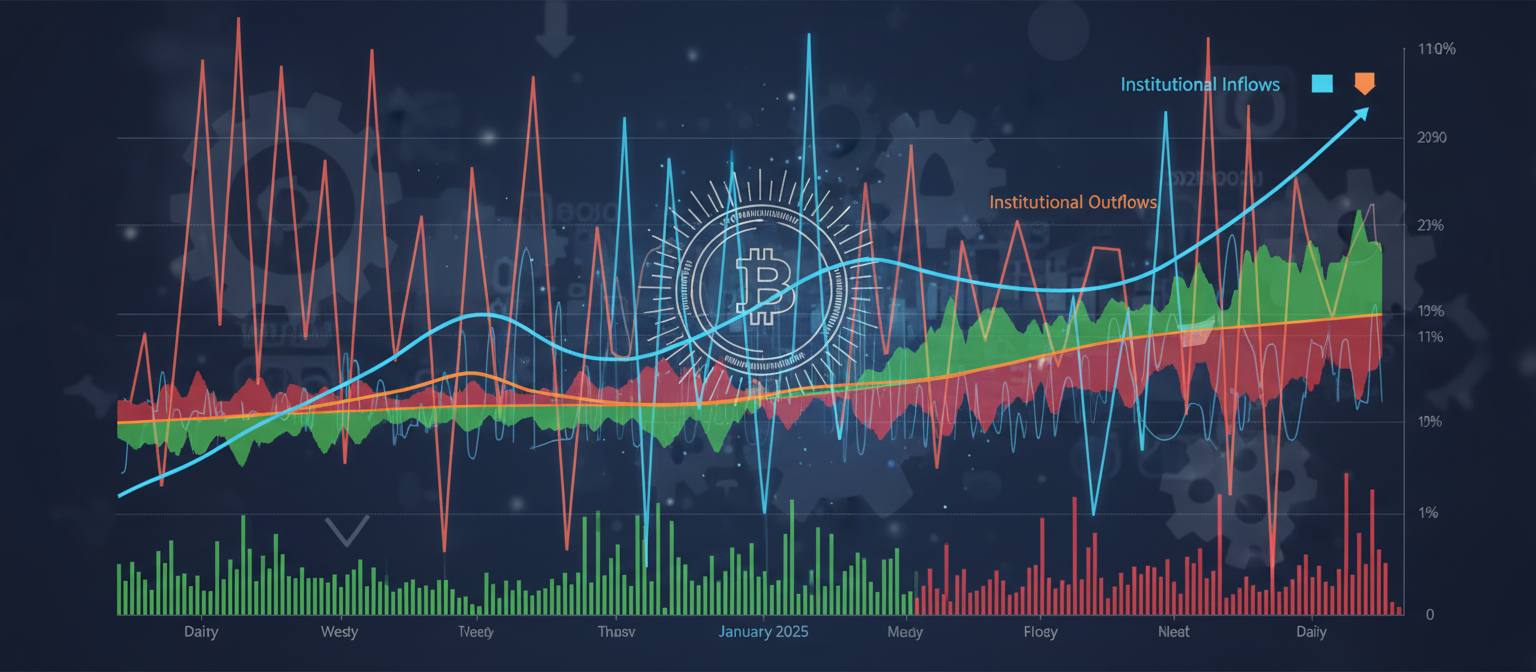
Bitcoin has experienced a turbulent beginning to 2025, with prices briefly dipping below $90,000 before rebounding above $97,000, yet institutional investors continue to demonstrate confidence in spot Bitcoin ETFs amid ongoing market uncertainty. The cryptocurrency’s volatile start to the year, influenced by Federal Reserve policy signals and broader macroeconomic concerns, has not deterred substantial institutional adoption of regulated investment products.
Despite Bitcoin’s modest 3.8% gain for the month, the underlying institutional demand remains robust, with major ETF providers like BlackRock’s IBIT and Fidelity’s FBTC maintaining significant inflows. This persistence suggests that institutional investors are taking a longer-term view, treating current price fluctuations as potential buying opportunities rather than reasons for concern.
Market Dynamics and Fed Influence
The current market volatility stems largely from speculation about the Federal Reserve’s limited capacity for further interest rate cuts in 2025. Recent Fed communications have suggested that the central bank may maintain higher rates for longer than previously anticipated, creating headwinds for risk assets including cryptocurrencies.
This macroeconomic uncertainty has particularly affected smaller cryptocurrencies, with Ethereum down 3.2% for the month, while Bitcoin has shown relative resilience. The divergent performance highlights Bitcoin’s evolving status as a potential safe-haven asset within the cryptocurrency ecosystem, with investors increasingly viewing it as a store of value rather than purely speculative investment.
Market analysts note that the current volatility represents a healthy consolidation following Bitcoin’s extraordinary 2024 performance, when the cryptocurrency gained over 130%. The pause in upward momentum may be creating a foundation for more sustainable growth, particularly as institutional infrastructure continues to mature.
ETF Supply Shock Intensifies
Behind the price volatility, a significant supply shock is developing in Bitcoin markets. Only 14.5% of Bitcoin’s circulating supply remains available on exchanges—the lowest level since 2018. This dramatic reduction in available supply reflects growing institutional accumulation and long-term holding behavior among investors.
The supply constraints are being exacerbated by continued ETF inflows, which are removing Bitcoin from circulation and placing it in institutional custody. BlackRock’s IBIT alone has seen substantial accumulation since its launch, with major financial advisors increasingly allocating client assets to the regulated investment product.
This supply-demand imbalance is creating upward pressure on Bitcoin’s price, even as short-term volatility persists. Market observers suggest that the combination of reduced exchange supply and continued institutional demand could set the stage for significant price appreciation once macroeconomic headwinds subside.

Institutional Integration Accelerates
The integration of Bitcoin ETFs into traditional financial portfolios continues to accelerate, with retirement plans and wealth management firms increasingly offering exposure to clients. Major asset managers have begun incorporating Bitcoin ETFs into model portfolios, treating them as alternative investments alongside gold and real estate.
This institutional integration is particularly significant given the vast scale of retirement assets in the United States, which exceed $43 trillion according to recent estimates. Even modest allocations to Bitcoin ETFs from this asset class could generate substantial demand, potentially amounting to hundreds of billions of dollars in additional inflows.
Financial advisors are reporting growing client interest in Bitcoin exposure through regulated ETFs, particularly as concerns about fiat currency devaluation and inflation persist. The ETF structure provides the regulatory compliance and custody arrangements that institutional investors require, overcoming previous barriers to cryptocurrency adoption.
Regulatory Clarity Drives Confidence
The ongoing regulatory clarity surrounding cryptocurrency ETFs has been instrumental in building institutional confidence. The SEC’s establishment of a Crypto Task Force and recent guidance on digital asset custody have created a more predictable regulatory environment for financial institutions.
Recent SEC decisions, including the rescinding of Staff Accounting Bulletin 121, have made it easier for banks and financial institutions to engage with cryptocurrency assets. This regulatory progress has been cited by institutional investors as a key factor in their decision to allocate capital to Bitcoin ETFs.
The anticipated approval of additional cryptocurrency ETF products, including potential Ethereum and other altcoin offerings, suggests that the regulatory environment will continue to evolve in favor of institutional adoption. This expanding product suite could provide institutions with more diverse exposure to the digital asset ecosystem.
Technical Outlook and Market Sentiment
Despite current volatility, technical indicators suggest a bullish medium-to-long-term outlook for Bitcoin. The cryptocurrency’s ability to maintain support levels above $90,000 during broader market weakness demonstrates underlying strength and accumulation behavior.
Market sentiment indicators show that institutional investors remain optimistic about Bitcoin’s prospects, with many viewing current price levels as attractive entry points. The combination of supply constraints, regulatory clarity, and growing institutional adoption provides a strong foundation for future price appreciation.
Risk factors remain, including potential regulatory setbacks and macroeconomic uncertainties. However, the growing institutional infrastructure and maturation of Bitcoin ETF products suggest that the market is becoming more resilient to external shocks and better positioned for sustainable growth.
Looking Ahead
As 2025 progresses, the trajectory of Bitcoin ETF institutional adoption will likely depend on several key factors. Continued regulatory clarity, particularly regarding additional cryptocurrency products and custody arrangements, will be essential for maintaining institutional confidence.
The broader macroeconomic environment, including Federal Reserve policy and inflation trends, will also play a crucial role in determining institutional allocation strategies. However, the fundamental supply-demand dynamics, combined with growing acceptance of Bitcoin as a legitimate asset class, suggest that institutional adoption will continue regardless of short-term market fluctuations.
For investors and market observers, Bitcoin’s volatile start to 2025 may ultimately prove to be a constructive consolidation phase, setting the stage for more sustainable institutional adoption and price appreciation in the coming months and years.
This article reflects market conditions and information available as of January 15, 2025. Market conditions may change rapidly, and readers should consult current sources for the latest developments.